
A six-foot white nutcracker can turn a store entrance, window, or holiday display into a clear focal point. But height alone does not make it the right retail choice. The 6′ Nutcracker White should suit the space, customer base, and practical demands of seasonal merchandising. Measure doorways and ceiling clearance before ordering, then check the product’s stated dimensions and base footprint. Scale matters. A figure that looks balanced in a catalog photo may feel crowded beside a narrow checkout or low display table.
Look closely at construction, finish, and stability. White surfaces can show scuffs and uneven paint, especially under bright shop lighting, so request current product photos or a sample when possible. Inspect how the hat, face, uniform, and trim are finished; small details can shape the perceived quality from several feet away. Ask suppliers about materials, assembly steps, packaging dimensions, and replacement-part availability. These details affect handling, storage, and setup—not just appearance. A sturdy base is important, though its weight and fastening options should match the intended floor and display location.
Compare landed cost, minimum order quantities, lead times, and delivery dates before committing. Seasonal inventory leaves little room for delays. Check the return terms, too. A useful decision balances visual impact with reliable specifications and manageable logistics. Still, color names can be imperfect; “white” may look warm, cool, or slightly cream under different lighting. Review the finish in context where possible, and make room for that uncertainty in your buying plan.
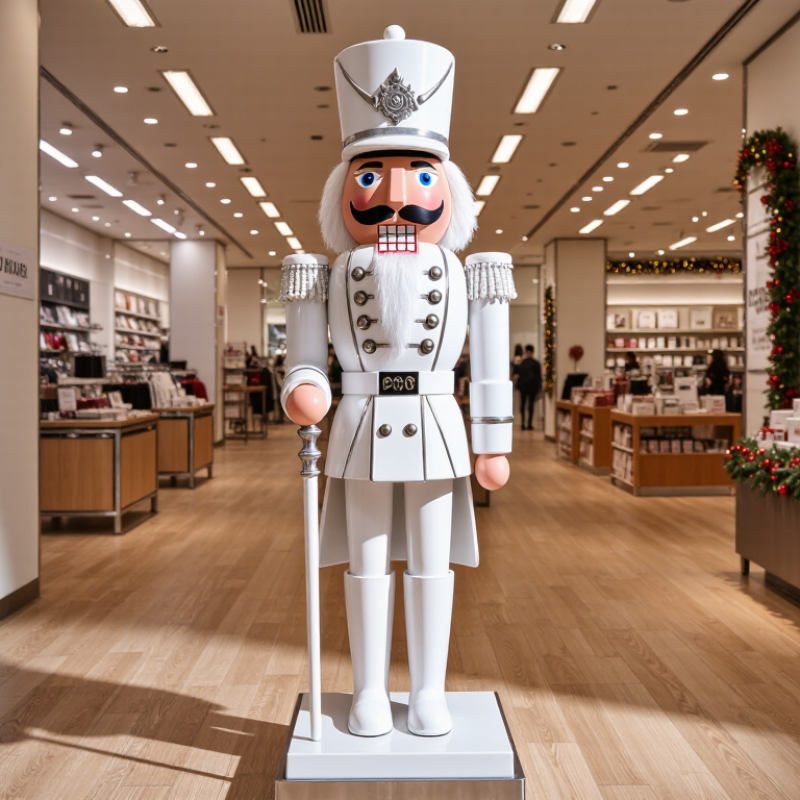
A 6-foot white nutcracker should be measured from its base to the highest point, including the hat or plume. Confirm the assembled height, not just the carton size. Retail floor space matters, too. Check the figure’s width and depth, then compare them with the planned display area. A broad base can improve stability, but it also takes up valuable space.
Look closely at the materials and finish. Resin and molded plastic can differ in weight, surface detail, and resistance to knocks. Ask whether the white coating is matte, glossy, or lightly textured; bright store lighting can make small scuffs more visible. Check how the face, buttons, and trim are applied. Painted details may vary slightly between pieces. That is worth inspecting. Request close-up photos or a sample when consistency across several units matters.
Weight and assembly details affect handling and storage. Ask for the packaged weight, base dimensions, and number of parts, along with clear setup instructions. A tall decoration may need extra support on a busy retail floor, even when it feels sturdy by hand. Confirm whether it is intended for indoor use, and do not assume a white finish is easy to clean. Dust can settle around carved features. It is a small nuisance, but real. Compare these specifications with your display plan before ordering.
A six-foot white nutcracker can look crisp on a showroom floor, but retail buyers should inspect what sits beneath the paint. Ask whether the body is molded resin, wood, or a lighter composite, and request material details rather than relying on appearance. Resin may handle damp conditions better than untreated wood, while a heavy wooden figure can feel steadier indoors. Neither choice is automatically best. Small details matter.
Check seams, joints, and the connection between the figure and its base. Gaps around a hat, arm, or boot can collect water, and loose fittings may shift during repeated handling. Examine a sample closely: are edges smooth, paint coverage even, and small parts firmly attached? A neat finish helps, but it cannot compensate for weak construction. I would also test how easily the piece tips on a hard floor.
For outdoor displays, look for clear guidance on moisture, temperature, and UV exposure. A weather-resistant label is useful, not a promise of year-round durability. Sunlight can dull white finishes, and wind can stress a tall figure even when its surface repels rain. Ask how the item should be cleaned, stored, and packed between seasons. One practical detail is easy to miss: a bulky product needs protective packaging that prevents its painted face from rubbing against the carton.
Material screening comparison for outdoor retail displays. Scores are indicative ratings from 1 (lower) to 5 (higher), not laboratory test results; coatings, joints, and maintenance can significantly affect performance.
Retail takeaway: Fiberglass-reinforced resin is often a practical choice for detailed, weather-exposed displays. Check the finish, seams, base stability, and manufacturer care guidance before selecting any 6-foot figure.
A six-foot white nutcracker can anchor a holiday display, but its details decide whether shoppers pause. Compare the face, uniform, and base from several steps away. Crisp painted eyes and restrained gold trim read clearly under warm shop lighting. A matte finish usually hides fingerprints better than gloss. Check the boots and base, too; a tall figure that wobbles can undermine the whole presentation. White also shows dust and scuffs, so inspect the finish in person when possible.
The U.S. Census Bureau reported that e-commerce represented 16.1% of total U.S. retail sales in the fourth quarter of 2024. Physical displays still have a distinct job: create a focal point shoppers can approach and photograph. The National Retail Federation forecast 2024 holiday sales of $979.5 billion to $989 billion. That forecast signals a busy seasonal market, not proof that any single decoration will sell. Scale and sightlines matter.
Tip: Measure ceiling height, aisle width, and the display footprint before ordering. Keep the figure’s face above nearby merchandise, and leave room around its base. Pair it with one or two smaller pieces, not a crowded row. I would not assume white fits every store; against pale walls, it can disappear. Test a sample beside the planned backdrop and check it under the actual lights.
A six-foot white nutcracker can attract attention, but its size changes the economics. Before ordering, compare landed cost, not just unit price: include packaging, freight, damage allowance, and any storage fees. Ask suppliers for carton dimensions and gross weight. A tall figure may incur dimensional-weight charges, even when its actual weight seems modest. Measure the receiving doorway and display area, too. Measure twice.
Seasonal timing matters. The National Retail Federation forecast 2024 November–December U.S. retail sales of $979.5 billion to $989 billion, up 2.5%–3.5% year over year. Adobe Analytics reported $241.4 billion in U.S. online holiday spending for the same season, an 8.7% increase. These figures signal broad seasonal opportunity, not guaranteed demand for oversized décor. Test a small quantity early, then reorder only if sell-through supports it. That is safer, though early forecasts can still miss.
Plan storage before the holiday rush. Keep cartons dry, upright, and away from heavy stock that could crush decorative details. Reserve enough floor space for safe handling; a large figure is awkward to move through a crowded back room. Set a markdown date before ordering, and estimate how many units must sell at full price to cover freight and storage. I would leave some margin for imperfect forecasts. A packed display can look festive, yet unsold stock takes up space long after the season ends.
| Assessment area | Planning measure | Indicative estimate or range | Retail planning note |
|---|---|---|---|
| Product and Cost Planning | |||
| Finished height | Nominal product height | 6 ft (72 in / approximately 183 cm) | Confirm whether the stated height includes the base, hat, or other projecting details. |
| Indicative packed size | Example carton dimensions | 18 × 18 × 76 in; approximately 14.3 cu ft | Planning example only. Request the actual carton dimensions before calculating freight or storage capacity. |
| Indicative packed weight | Per-carton gross weight | Approximately 15–30 lb | Construction and packaging can change weight substantially; use the supplier’s confirmed shipping weight. |
| Wholesale product cost | Illustrative unit-cost assumption | US$60–US$120 per unit | Use supplier quotations for buying decisions. Finish, materials, order quantity, and included accessories affect cost. |
| Landed cost | Calculation method | Product cost + freight + duties and taxes + handling | Calculate from the actual purchase terms and destination charges; do not treat product cost alone as landed cost. |
| Retail price and gross margin | Illustrative example | US$199 retail price and US$100 landed cost = approximately 50% gross margin | Gross margin = (retail price − landed cost) ÷ retail price. This example excludes operating expenses, markdowns, and returns. |
| Shipping and Storage | |||
| Domestic less-than-truckload shipping | Typical planning lead time | Approximately 3–10 business days, route dependent | Large cartons may incur freight minimums or additional handling. Confirm delivery appointment and residential or liftgate fees where relevant. |
| Ocean import lead time | Port-to-port planning range | Approximately 25–40 days, subject to route and conditions | Allow additional time for origin handling, customs clearance, port congestion, and inland delivery. |
| Import buffer | Recommended planning allowance | At least 2–4 additional weeks beyond the expected transport schedule | Build in a buffer for inspection, documentation, delays, and receiving. Confirm current schedules with the freight provider. |
| Storage footprint | Example carton floor area | 18 × 18 in = 2.25 sq ft per carton before aisle space | Actual warehouse allocation must also account for safe stacking limits, access, and movement space. |
| Storage protection | Handling conditions | Keep cartons dry, clean, and away from crushing loads | Protect white finishes from dust, moisture, scuffing, and prolonged exposure to direct sunlight. |
| Display and replenishment | Operational consideration | Keep one display unit accessible and reserve boxed stock nearby when space allows | Check carton condition and product finish before placing the display unit on the sales floor. |
| Seasonal Demand and Buying Decisions | |||
| Illustrative seasonal sales profile | Share of annual unit sales used for planning | September–October: 15%; November: 40%; December: 45% | This is a sample planning profile, not a market-wide measured statistic. Adjust using store-level sales history and local customer behavior. |
| Initial inventory decision | Demand inputs | Prior-season sales, display capacity, lead time, and reorder availability | Buy conservatively when replenishment is possible; increase the initial order only when demand history and lead times support it. |
| Markdown exposure | Risk period | Highest after the main holiday selling window | Set a sell-through review date and markdown plan before the season begins to limit leftover bulky inventory. |
| Final selection checklist | Compare before ordering | Unit cost, landed cost, carton size, packed weight, finish quality, and delivery date | Request a sample or detailed product photos, written specifications, packaging details, and a confirmed shipping schedule. |
| Data note: Cost, packed-size, packed-weight, and sales-profile figures above are clearly labeled planning examples or indicative ranges, not guaranteed specifications or universal market averages. Replace them with current quotations, confirmed product measurements, destination-specific freight rates, and your own sales history. | |||
When choosing a six-foot white nutcracker for retail, verify the supplier before relying on attractive product photos. Ask how long the supplier has produced seasonal décor and request recent references from comparable buyers. Check that the quoted lead time, carton dimensions, and replacement-part policy are provided in writing. Details matter.
Request safety documentation for the exact model, not a similar-looking sample. Reports should identify the product, materials, and tested components, such as paint or electrical parts if the figure is illuminated. Confirm that the documentation fits your intended sales markets; requirements can differ. A stable sample should stand on a level floor without rocking, and its finish should resist light handling without visible flaking. These checks help, but a sample cannot reveal every production variation.
Tips: Compare the report’s model number with the purchase order. Ask for dated factory photos and a pre-shipment inspection. Keep one approved sample for comparison. If paperwork is vague, or answers keep changing, pause before placing a large order. A neat file is reassuring, but it is not proof by itself.
Measure from the base to the highest point, including its hat or plume. Confirm the assembled height, not the carton size. Small difference, big headache.
Check the figure’s width, depth, and base dimensions. Compare them with ceiling height, aisle width, and available floor space. Leave room around the base.
Resin and molded plastic can differ in weight, detail, and resistance to knocks. Ask whether the white finish is matte, glossy, or textured. Lighting changes everything.
Inspect close-up photos or request a sample. Look at the face, buttons, trim, boots, and base. Painted details may vary slightly between pieces. That can be noticeable.
Check the base size and assembly instructions before setting it up. A broad base may improve stability, but it uses more floor space. Test it carefully.
Compare landed cost, not just unit price. Include packaging, freight, possible damage, and storage fees. Ask for carton dimensions and gross weight. Measure twice.
Check whether the packaged figure will fit through the receiving doorway. Confirm the number of parts and setup steps. Tall decorations can be awkward to move.
Store cartons upright, dry, and away from heavy items. Test a small quantity early, then reorder if sales support it. Forecasts can miss. Leave room for that.
Choosing the best 6′ White Nutcracker for retail starts with checking its overall dimensions, proportions, finish, and suitability for the intended display space. Compare materials and construction to determine whether the figure can withstand frequent handling and, if displayed outdoors, changing weather. Stable support, durable coatings, secure decorative elements, and easy-to-clean surfaces can all affect its lifespan. Design details such as facial expression, clothing, color consistency, and craftsmanship also shape its visual appeal and how well it complements a store’s seasonal presentation.
Before ordering, evaluate the full cost, including shipping, packaging, storage needs, and the timing of seasonal demand. Confirm that the product can be transported and stored without damage, and ask suppliers for clear specifications, care guidance, and information about relevant product safety standards. A careful comparison of quality, display appeal, logistics, and supplier reliability can help retailers select a 6′ Nutcracker White that fits their budget and serves their seasonal display needs.
